
Nursing Home Beds: 10 Criteria for Choosing Care Beds
A practical purchasing guide for long-term care beds, including resident needs, height adjustments, bed accessories and a real-room trial.
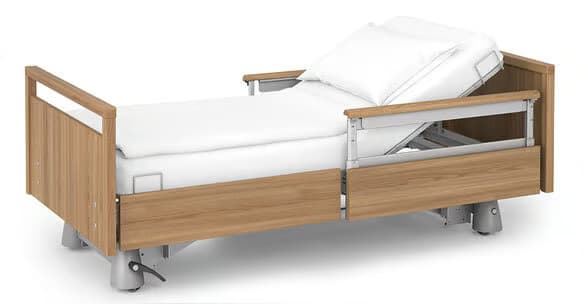
A practical purchasing guide for long-term care beds, including resident needs, height adjustments, bed accessories and a real-room trial. Read the comparison, review the practical checks, and adapt every recommendation to your residents, facility protocols and the product manufacturer’s instructions.
What is the best bed for a nursing home?
There is no single best nursing home bed for every resident. The appropriate model depends on the resident’s mobility, transfer needs, body size, pressure injury risk, sleep habits and the available space and staffing. A facility should compare care beds against the same requirements and complete a practical room trial.
| Resident need | Bed features to investigate |
|---|---|
| Frequently exits bed independently | Adjustable bed-exit height, mobility support, clear circulation |
| At risk of falling from bed | Lower resting position, individualized risk assessment and room layout |
| Needs regular nursing care | Suitable care height, access from both sides, ease of adjustment |
| Uses patient lifts | Chassis clearance, lift leg access, transfer space |
| Requires larger sleeping surface | Documented size, resident weight limit and safe working load |
The 10 criteria for choosing nursing home beds
- Resident profile: distinguish mobility, cognitive status, weight, height and ability to use controls.
- Height range: test resting, standing and nursing care heights separately.
- Bed positioning: check backrest, knee break, controls and clinical suitability.
- Transfer support: review mobility aids, transfer techniques and patient-lift compatibility.
- Side rails: evaluate restraint and entrapment risks for each resident and mattress.
- Load ratings: compare safe working load separately from maximum resident weight.
- Room compatibility: confirm width, length, under-bed space and circulation.
- Brakes and handling: test turning, transport and access to brake controls.
- Cleaning: assess mattress, surfaces, joints and accessory maintenance.
- Whole-life cost: include mattresses, delivery, training, parts, warranty and service.
For each requirement, ask suppliers for model-specific proof and distinguish included features from optional accessories.
Why bed height is not just a single number
A low sleeping platform may reduce bed-to-floor distance for selected residents. It does not guarantee fall prevention and may make standing more difficult if it is too low at the time of bed exit. During nursing care, an adjustable raised position may help caregivers avoid excessive bending. The suitable heights depend on the resident, mattress and care process.
| Use | On-site test |
|---|---|
| Sleep/rest | Observe positioning and risk at the intended low setting |
| Bed exit | Assess feet on floor, transfer and stable sitting |
| Care provision | Check caregiver reach and working posture |
| Patient lift | Check clearance and moving room |
Which types of long-term care beds should you compare?
Standard adjustable care beds
A flexible option for everyday positioning, hygiene tasks and supported transfers when the configuration matches resident needs.
Ultra-low geriatric beds
Designed to support a very low resting position, with a separate tested height for standing and caregiving. Learn more in the low beds for elderly residents guide.
Mobile or lift-accessible beds
Prioritize turning, caster configuration, brake access and compatibility with the patient-lift equipment used in your facility.
Bariatric and extra-wide care beds
Compare bed deck width, external dimensions, maximum resident weight and safe working load. These are different specifications.
Sentida SC configurations by wissner-bosserhoff
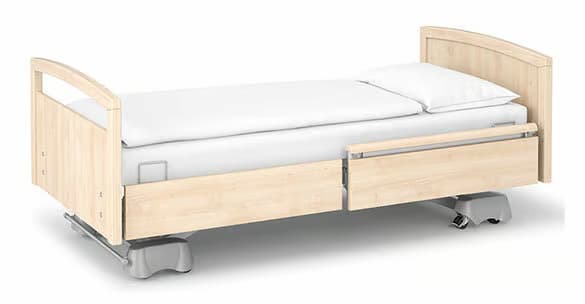
Sentida SC is developed and sold by wissner-bosserhoff, not Domalys. Both brands belong to LINET Group. The manufacturer offers several Sentida SC chassis and width configurations including accessible and extra-mobile options, alongside wider models for specific needs.
The standard Sentida SC reference has an adjustment range of 23–80 cm depending on the caster configuration. The manufacturer identifies 23 cm for low rest, 31 cm for an intermediate stop, 41 cm for mobilization and 80 cm for nursing care. Confirm the exact model and local availability with wissner-bosserhoff.
| Variant or feature | Purpose to verify |
|---|---|
| Cosy / homelike chassis | Residential appearance and movement within the room |
| Extra-mobile chassis | Moving the bed and managing brakes in long-term care |
| Accessible chassis | Extra clearance for compatible patient lifts |
| SC-XL / SC-XXL | Additional bed width or specialized capacity, according to model |
| SafeFree / SafeSense | Segmented side rails or optional bed-exit assistance where specified |
Essential bed accessories: what should be specified?
The purchase decision includes more than the frame. A mattress must fit the deck, side rails and clinical needs. Mobility supports, trapeze bars, handset holders, under-bed lights or bed-exit notification systems may also be considered. Never assume accessories are universally compatible or standard in every package.
- Specify mattress width, length, depth and pressure care requirements.
- List required side rails, including position and individual restraint considerations.
- Check patient-lift and mobility-assist mounting instructions.
- Document which alarms are connected to the facility call system.
- Record care and cleaning instructions for accessories and controls.
A real-room trial for new nursing home beds
Invite representatives from nursing, physical and occupational therapy, housekeeping and maintenance, together with resident input wherever possible. Use the same route and assessment criteria for each candidate.
Facility trial checklist
Check each item during an on-site trial. You can print this page with your browser’s Print command.
Photographs and a completed checklist are useful supporting records, but the final selection should reflect an individualized care and procurement decision.
Compare price, supplier support and lifecycle costs
A care-bed quote should identify the model, chassis, casters, mattress, side rails, controls, accessories, freight, assembly, training, warranty, spare parts and expected maintenance. Do not compare a bare base price against a complete installed configuration.
In a multi-bed project, consider a limited trial and document results before ordering for an entire unit. Record available service support in the country where the beds will actually be operated.
Buying mistakes to avoid
- Choosing by color or product photography before defining functional needs.
- Confusing safe working load with permitted resident weight.
- Assuming every low bed includes night lighting and bed-exit alerts.
- Treating full-length side rails as universally appropriate.
- Ignoring mattress depth and potential entrapment zones.
- Failing to test the actual patient lift and doorway clearances.
- Mistaking the LINET Group connection for Domalys selling Sentida SC.
Frequently asked questions
What is the best nursing home bed?
There is no universal best bed. Match the resident’s clinical and mobility needs to the bed height, dimensions, safe loads, accessories and care environment.
What is the benefit of an adjustable nursing home bed?
Different heights and positions can support rest, transfers and caregiver access, depending on the resident and the model.
Are lower beds safer for residents at risk of falling?
A low bed may help address specific bed-to-floor risks, but it does not eliminate falls. Test actual bed exit and room conditions.
What are safe working load and maximum resident weight?
Safe working load refers to the rated total load under defined conditions. Maximum resident weight is a distinct manufacturer specification.
What accessories should be included in a care-bed quote?
List the mattress, side rails, mobility supports, controls, lighting, accessories, installation, training and maintenance as separate line items.
Who manufactures Sentida SC beds?
Sentida SC is manufactured and marketed by wissner-bosserhoff, a LINET Group brand; Domalys does not sell these beds.
Should a nursing home trial beds before buying?
Yes. Test the actual care room, resident and caregiver tasks, lift clearance, braking, maneuvering, cleaning and service support before a large purchase.
Explore related resources
Sources and editorial notes
This guide is educational and is not a substitute for clinical assessment, local policy or manufacturer documentation. Terminology and requirements may vary by US state or care setting.
- wissner-bosserhoff — Sentida SC product specifications
- wissner-bosserhoff — Sentida SC XXL
- FDA — Hospital Beds and bed system safety
- OSHA — Nursing home ergonomics
Editorial author: Dylan Fournier, Digital Marketing Specialist at Domalys by LINET.
Review your care environment with Domalys
Tell us about your facility, the workflows you want to improve and the products you wish to evaluate. Our team can help you identify relevant solutions and organize a demonstration.
Request a demonstration