
5 Times Sit to Stand Test: Protocol, Scoring and Interpretation
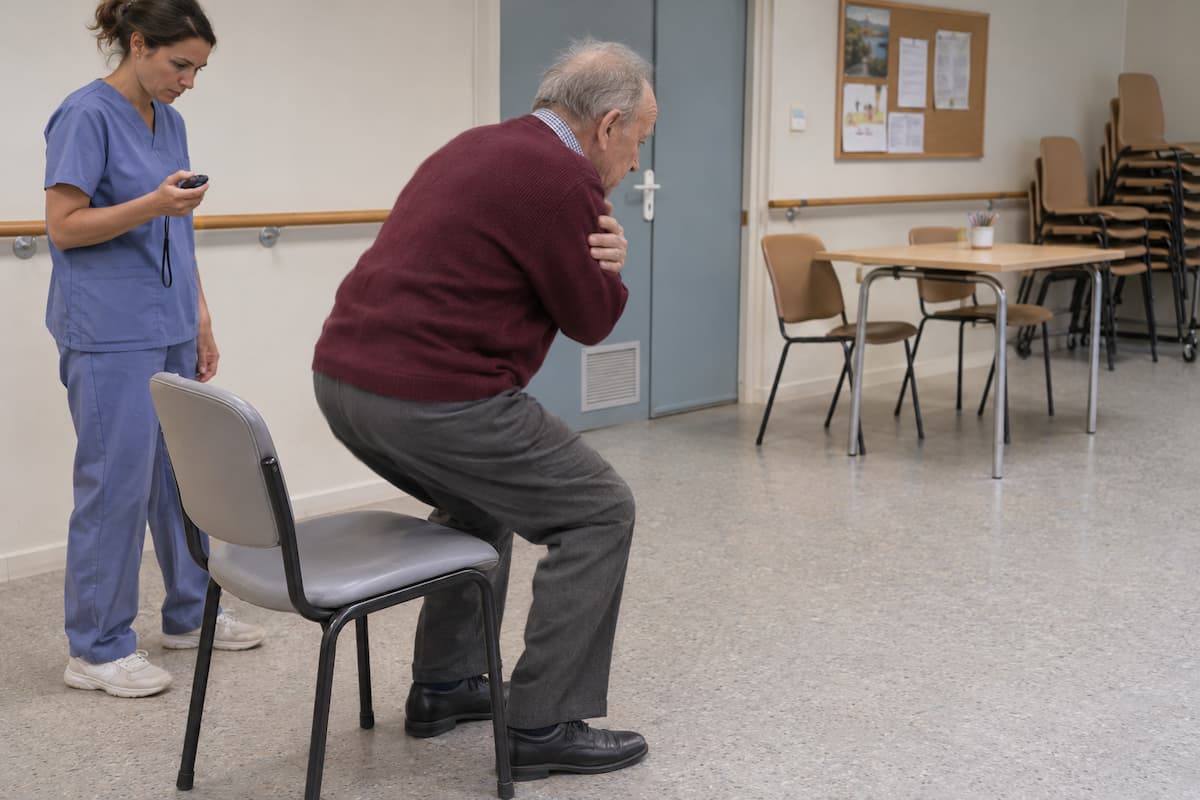
The 5 Times Sit to Stand Test (5xSTS) measures how long it takes to stand fully upright and sit back down five times with arms folded across the chest. In the protocol described here, timing starts on the examiner’s cue and ends when the person sits down for the fifth time. Record the result in seconds.
Two residents can both finish in 16 seconds. One hesitates before getting off the seat. The other takes longer to lower into the chair each time. The charting worksheet gives you a way to record that difference.
- Use the same chair at follow-up and record its seat height.
- Document whether the resident completed all five repetitions without pushing off with their hands.
- Consider how the resident gets up during the day, for instance when leaving the dining table after a meal.
How do you administer the 5 Times Sit to Stand Test?
Before starting, ask how the resident usually gets out of a chair. If they need someone to lift them or the first stand looks unsafe, skip the timed series. Stay close enough to assist.
- Set up the chair. Use a stable, non-wheeled chair with a backrest and armrests. Clear the floor around it. RehabMeasures describes a seat height of 17–18 inches (43–45 cm). Measure the seat and use the same chair at reassessment.
- Demonstrate the movement. Start with the resident’s back against the backrest, feet on the floor and arms folded across the chest. Show one full stand and return to sitting. Allow a practice trial and enough rest before recording the timed trial.
- Start on the cue. Ask the resident to stand up fully and sit down five times as quickly as they safely can. Start the stopwatch on the verbal cue. Count each time the resident reaches a full standing position.
- Stop and record. Stop as soon as the resident’s bottom touches the seat after the fifth stand. Record the time in seconds, seat height and anything that affected the movement.
Stop if the resident feels dizzy, reports unusual pain, loses balance or asks to stop. If you need to steady them, document the assistance and how many stands they completed.
5xSTS administration guide, Shirley Ryan AbilityLab
How do you interpret the 5xSTS score and age norms?
A longer time means the resident took longer to complete the task. Look at which part slowed them down: getting off the seat, straightening up or lowering back into the chair. Leg strength, balance and pain during the movement can all affect performance.
| Age | Mean reference time |
|---|---|
| 60–69 years | 11.4 s |
| 70–79 years | 12.6 s |
| 80–89 years | 14.8 s |
These figures come from Bohannon’s 2006 meta-analysis. They put performance in the context of age. A nursing home resident may differ substantially from the people included in those studies. Read the meta-analysis.
What does a time of 15 seconds mean?
French national guidance lists inability to complete five chair rises in under 15 seconds as one sign of reduced muscle strength in older adults at risk of falling. This finding can prompt a closer look at strength and everyday transfers. See the French National Authority for Health guidance.
Buatois and colleagues studied recurrent falls in 1,618 community-dwelling adults aged 65 or older. A time over 15 seconds added information particularly for people already in an intermediate-risk group. The study does not establish an individual nursing home resident’s likelihood of falling. Read the study by Buatois and colleagues.
Five Times Sit to Stand charting worksheet
What will the colleague repeating this test need to know? Choose how the trial ended and what you observed. You can then copy the note into the resident’s chart and date it there.
Sample chart entry after five stands
“Five stands in 16.2 s. Seat height 45 cm, arms folded. Timed through fifth seat contact. Lowered more slowly on the last two repetitions.” At the next visit, the examiner can reproduce the setup and check whether lowering still takes extra time.
Sample chart entry when the resident pushes off
“Two stands without support. Pushed off the armrests on the third attempt. Standard trial ended.” The useful detail for the next shift is when the resident needed support. Entering zero seconds would make an incomplete trial look exceptionally fast.
If a time changes from 17 to 14 seconds, check the chair, instructions and timing endpoint first. Ask whether getting up from the resident’s usual chair feels easier as well. A three-second change has different implications across clinical populations.
Which test answers the next mobility question?
A resident may manage five chair stands yet hesitate when turning with a walker. Choose the next assessment around the movement that causes difficulty.
Standing, walking and turning
The Timed Up and Go (TUG) test includes a chair rise, a three-meter walk, a turn and a return to sitting. Watch how the resident goes from standing to taking the first steps.
Looking at gait and balance
The Tinetti assessment breaks gait and balance down into individual tasks. It can help describe what happens as the resident steadies themselves or changes direction.
For lower-limb endurance, the 30-second chair stand fixes the time and counts stands. The 5xSTS fixes the number of stands and measures time. The scores use different units. See the CDC STEADI chair stand form.
Frequently asked questions about the 5xSTS
Can the resident use the armrests?
For the standard test, the arms remain folded. If the resident needs the armrests, allow the support they need for safety and document the assisted transfer separately.
How much time should I allow?
RehabMeasures lists an administration time of less than five minutes, depending on the number of trials. Allow time to explain the movement and let the resident recover before starting the stopwatch.
What is a normal time for someone over 90?
The cited meta-analysis reports age groups up to 80–89. For someone aged 90 or older, their own previous results under the same conditions and how they manage daily transfers can provide context.
Does a slow score diagnose sarcopenia?
Difficulty standing can point to low muscle strength. Determining the cause and assessing possible sarcopenia requires clinical examination and other findings.
Should a resident take the test after every fall?
After a fall, the immediate priority is the resident’s condition and assessment for injury. The care team can then decide whether a chair stand test would be informative and safe.
Clinical references
- Shirley Ryan AbilityLab, RehabMeasures. Five Times Sit to Stand Test protocol and equipment.
- Bohannon RW, 2006. Meta-analysis of five-repetition sit-to-stand reference values.
- Buatois S and colleagues, 2010. Prospective study of recurrent falls in community-dwelling adults.
- French National Authority for Health, 2024. Older adults at risk of falls (in French).
- Look AHEAD SPPB protocol. Repeated chair stands, page 9.
- CDC STEADI. 30-Second Chair Stand assessment.
Putting chair stands in the context of a fall
Was the resident getting up, walking or lowering into the chair when they fell? Their account and the team’s observations help determine what to assess next.