
Timed Up and Go (TUG) Test: Procedure and Fall Risk
The Timed Up and Go (TUG) test is a standardized assessment of functional mobility in older adults. From a standard armchair, the patient stands, walks 3 meters (10 feet), turns, returns and sits down while a healthcare professional records the total time. The test also reveals difficulties with transfers, gait speed, balance and turning that a number alone may conceal.
In nursing homes, this brief assessment can support fall risk screening and rehabilitation follow-up, particularly for elderly residents living with frailty, Parkinson’s disease or after a stroke. An appropriate clinical evaluation considers previous falls, illness, medication and the environment alongside the result. Below are the practical procedure, one practice trial, CDC and French HAS reference thresholds, and ways to turn observations into an individualized prevention plan.
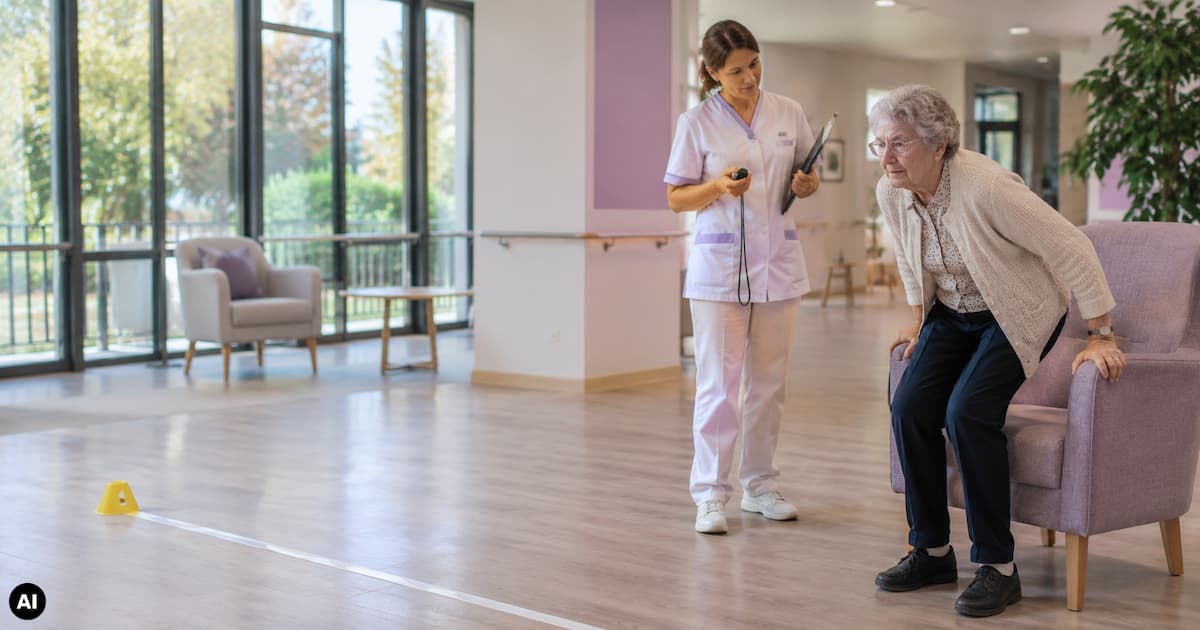
- Route: stand up, walk 3 meters (10 feet), turn, return and sit down.
- Measurement: time the full sequence in seconds and note any movement difficulties.
- Interpretation: apply the relevant clinical framework and complete a multifactorial assessment.
A slower time can flag mobility difficulties, but no single TUG result can predict whether an individual will fall.
What Is the Timed Up and Go (TUG) Test?
The Timed Up and Go test, commonly abbreviated as TUG, is a brief performance-based assessment of functional mobility. It combines everyday movements: standing up from a chair, starting to walk, turning, returning and sitting down. The result is recorded in seconds, alongside observations of how the person completes each movement.
In nursing homes and other long-term care settings, the TUG can help clinicians describe mobility limitations, follow changes over time and decide whether a more comprehensive assessment is needed. It complements the resident’s fall history, physical examination and day-to-day observations of transfers and walking.
Distance from the chair to the turning marker (about 10 feet).
Stopwatch used to time the entire round trip.
Turn at the marker, then turn again to sit; observe stability.
What does the test measure, and what does it not measure?
Podsiadlo and Richardson introduced the timed version in 1991 as a test of basic functional mobility for frail elderly persons, published in the Journal of the American Geriatrics Society. Their work linked TUG performance with measures such as the Berg Balance Scale, walking speed and activities of daily living. The TUG is therefore useful for describing how a patient moves, rather than identifying the cause of a disease or assigning an individual probability of falling.
Research also includes community-dwelling older adults, people recovering from stroke, patients with Parkinson’s disease and people with vestibular disorders. Those populations do not have identical mobility profiles or reference values. A result from an independently living adult should not be applied without qualification to a frail nursing home resident. For administration details and measurement evidence, consult the RehabMeasures clinical reference.
How to Perform the Timed Up and Go Test
Prepare a stable armchair, a stopwatch and a floor marker 3 meters (approximately 10 feet) from the chair. The route should be level, clear and well lit. The resident should wear their normal shoes and may use their usual walking aid when appropriate for the protocol and the person’s safety.
- Seat the resident. Ask them to sit back in the chair, with their feet placed securely on the floor.
- Explain the route. Stand on the signal, walk to the marker, turn, return and sit down.
- Start the timer. Begin timing when you say “Go,” not only once the resident begins to move.
- Stop and document. Stop when the resident sits back down. Record the total seconds and your observations.
What should you observe beyond the stopwatch?
Watch for difficulty rising, heavy reliance on the armrests, hesitancy when initiating gait, short or shuffling steps, instability on turning, reliance on furniture or improper use of a walker. These observations may highlight limitations that a single elapsed time cannot explain.
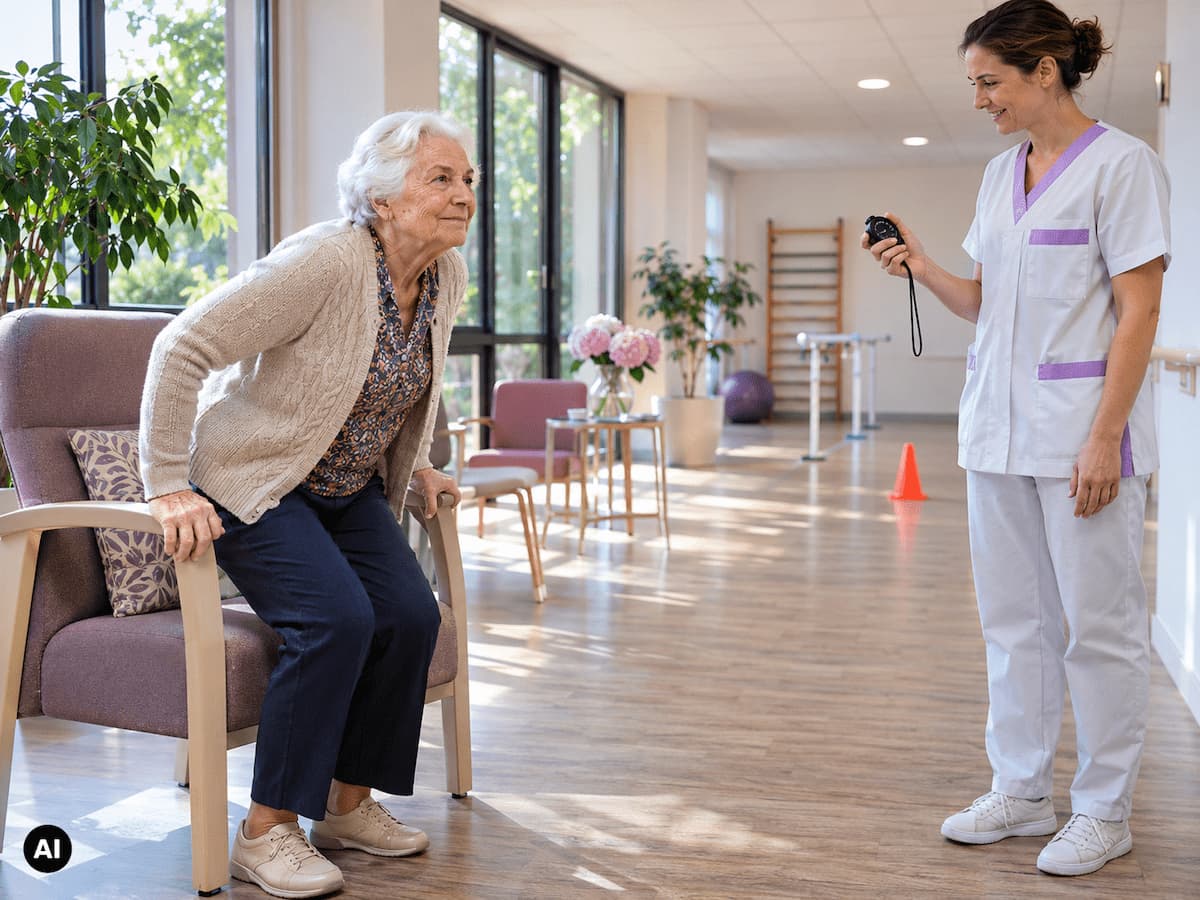
Practice trial and standardized conditions
The RehabMeasures protocol describes one practice trial before the timed attempt; the familiarization trial is not included in the recorded score. Use a standard armchair, preferably with a consistent seat height and armrests, and record the patient’s usual footwear and assistive device. Never change the walking instructions or speed between visits without documenting the difference.
For follow-up, note the date, measured time, first trial status, chair, shoes, walking aid, need for assistance and any pauses. This avoids confusing a change in equipment or test administration with a true change in mobility.
How Do You Interpret TUG Test Results?
There is no single cutoff that applies to every nursing home resident. Published thresholds depend on the population, screening purpose and clinical framework. Two well-known sources use different criteria:
| Clinical reference | Time threshold | How to interpret it |
|---|---|---|
| French HAS, 2024 | More than 15 s | Marker of impaired gait or balance within a broader falls risk-stratification algorithm for older adults. |
| CDC STEADI, United States, 2017 | 12 s or longer | Screening threshold that may warrant further assessment of an older adult’s fall risk. |
Illustrative result: 11 seconds
A relatively quick result may indicate good performance on this task. It does not rule out falls associated with medications, acute illness, nighttime conditions or other risk factors.
Illustrative result: 19 seconds
The time exceeds the French HAS 2024 reference marker. Clinicians should investigate what makes the task difficult and whether targeted interventions are indicated.
Why do TUG cutoffs and normative values vary?
Earlier work by Shumway-Cook and colleagues (2000) explored fall risk among community-dwelling older adults. However, a 2014 systematic review and meta-analysis found limited accuracy when a single 13.5-second cutoff was used to predict falls in this population. The message for nursing homes is practical: no number replaces a wider clinical assessment.
Normative data, test-retest reliability, inter-rater reliability and the minimal detectable change also depend on the population and study. An intraclass correlation coefficient (ICC) describes measurement agreement; it does not make all differences in seconds clinically meaningful. After a stroke, with Parkinson’s disease or with vestibular disorders, mobility limitations and appropriate comparisons may differ. Use population-specific evidence instead of applying one universal change threshold.
How Can Nursing Homes Use the TUG Test?
The TUG provides a simple, shared way for nursing home teams to describe mobility. It may be useful during an appropriate mobility assessment, after a meaningful change in health status or as part of rehabilitation follow-up when it can be administered safely.
Identify specific difficulties
Find out whether the resident struggles most with standing up, walking, turning or sitting down, and where assistance may be needed.
Monitor changes over time
Compare results obtained under similar conditions while considering everyday independence, staff observations and the resident’s personal goals.
Illustrative nursing home case: two assessments, different conditions
A hypothetical resident completes the TUG in 18 seconds, with an unsteady turn and heavy reliance on the chair’s armrests. Two weeks later, the same resident records 15 seconds, but this time uses a different walking aid. The team should not immediately conclude that mobility improved: the change in the device may account for part of the difference.
The care team documents the walking aid, checks transfers and gait, reviews medication and recent illness, and examines the room’s walking routes. This example illustrates why a standardized procedure and direct observations matter more than the raw time alone. The result adds context to the facility’s fall-prevention strategy; it does not replace physical therapy assessment or medical judgment.
TUG Test vs. Tinetti Test: What Is the Difference?
The TUG records the time needed to complete a functional mobility task. The Tinetti Performance Oriented Mobility Assessment (POMA) scores several balance and gait tasks separately. They provide related but different clinical information.
| Criterion | TUG test | Tinetti POMA |
|---|---|---|
| Main measure | Elapsed time in seconds | Balance and gait score out of 28 points (common version) |
| Observed tasks | Stand, walk 3 m, turn, return, sit | Series of static and dynamic balance and gait tasks |
| Main benefit | Quick observation of functional mobility and follow-up | More detailed picture of balance and walking difficulties |
| Main limitation | Time alone does not explain every source of instability | A total score can hide different patterns in the subscores |
Read the Domalys Tinetti assessment and scoring guide for more on the POMA.
What Should Caregivers Do After a Concerning TUG Result?
A slow result, loss of balance or deterioration from a previous assessment should prompt a review of modifiable factors by qualified healthcare professionals. It should not trigger the same intervention for every resident.
1. Investigate causes
Review previous falls, pain, fatigue, vision, blood pressure changes, medication effects, neurologic conditions and recent illness.
2. Support mobility
Consider individualized physical therapy, balance training, strengthening and transfer practice where clinically appropriate.
3. Improve the environment
Check the area around beds and chairs, walking routes to the bathroom, obstacles, assistive devices and nighttime lighting.
4. Review alerts and response
Ensure the resident has a suitable way to call for assistance and that caregivers can respond through an agreed workflow.
After an actual fall, follow the nursing home post-fall protocol. A TUG score is never a substitute for urgent assessment when signs of serious injury or acute illness are present.
Where Does Aladin+ Fit Into Fall Prevention?
Aladin+® is a room-based fall detection device with automatic lighting and caregiver alerts, without a camera or wearable device. It may complement a broader care plan when nighttime mobility, visibility or timely notification are relevant needs.
The TUG does not evaluate whether a resident can locate a light switch in the dark or summon help after a fall. The room environment and the bed-to-bathroom route therefore deserve their own assessment.
Aladin+ does not administer the TUG, predict future falls or treat gait disorders. The choice and configuration of any monitoring system should be based on the facility’s care practices and individual needs.

Example: good daytime mobility, but nighttime difficulties
A resident completes the TUG in 11 seconds during the day, yet struggles to navigate between bed and bathroom after lights-out. The team should review lighting, obstacles, access to walking aids and alert arrangements. See the Domalys guide to nighttime falls.
Five Mistakes to Avoid With the TUG Test
- Changing the procedure between assessments without recording differences in the chair, distance, instructions or walking aid.
- Treating a cutoff as certainty about a resident’s future falls.
- Ignoring movement quality such as hesitant turns, shuffling or unexpected use of supports.
- Testing without suitable supervision when a resident is unstable or acutely unwell.
- Choosing one piece of equipment instead of assessing and addressing multiple risk factors.
Timed Up and Go (TUG) Test FAQ
What is a normal TUG test time for older adults?
There is no universal normal time for every older adult. The CDC STEADI assessment uses 12 seconds or longer as a screening threshold, while French HAS guidance published in 2024 uses more than 15 seconds within its assessment algorithm. Interpret results in clinical context.
How far does the person walk during the TUG test?
The person walks 3 meters (approximately 10 feet) from the chair to a marker and 3 meters back. Standing up, turning and sitting down are all included in the timed task.
Can a resident use a cane or walker during the test?
Yes, when appropriate to the protocol and safety requirements. Record the usual mobility aid and maintain comparable conditions for repeat assessments.
Does a slow TUG result mean a resident will fall?
No. A slower result can flag mobility difficulties, but it cannot individually predict a fall. A multifactorial assessment should consider fall history, health status, medications and environment.
Who should administer the TUG in a nursing home?
A trained professional who can follow the assessment instructions and provide appropriate safety support. The care team should interpret the result within the overall clinical assessment.
How often should the TUG test be repeated?
There is no single schedule for every resident. Follow-up depends on clinical needs, changes in function, falls and rehabilitation goals. Document the date and assessment conditions.
Does the TUG replace the Tinetti assessment?
No. They are complementary: the TUG times a functional mobility task, while the Tinetti POMA scores several balance and gait activities.
References and Further Reading
- CDC STEADI, 2017 – Timed Up & Go (TUG) Assessment: three-meter protocol, movement observations and the 12-second screening threshold.
- French Haute Autorité de Santé, March 2024 – Older Adults at Risk of Falling: gait impairment assessment and the greater-than-15-second reference in a broader algorithm.
- Shirley Ryan AbilityLab – Timed Up and Go, RehabMeasures Database: test administration, reliability and interpretation considerations.
- NICE NG249, 2025 – Falls: assessment and prevention: multifactorial assessment and limitations of falls prediction tools.
- Podsiadlo and Richardson, 1991 – The Timed Up & Go: original functional mobility study involving frail elderly people.
- Shumway-Cook et al., 2000 – Falls in community-dwelling older adults: historical research on fall-risk screening.
- Barry et al., 2014 – Systematic review and meta-analysis: evidence on the limits of a single TUG cutoff for predicting falls.
Also assess nighttime mobility and room safety
One time measurement cannot describe all the situations in which an elderly patient may fall. Clinical history, disease-related limitations, transfers after stroke, assistive devices and nighttime routines require their own assessment. A standardized chair, comparable testing conditions and observation of gait help make follow-up more meaningful. When the team identifies visibility or alerting needs, Domalys can explain how automatic lighting and camera-free fall detection may complement the care plan. The starting point remains a well-documented Timed Up and Go (TUG) test, interpreted alongside the resident’s everyday mobility and risk factors.

Digital Marketing Specialist at Domalys by LINET. Editorial content on fall prevention and equipment for nursing homes. Updated November 17, 2026.